
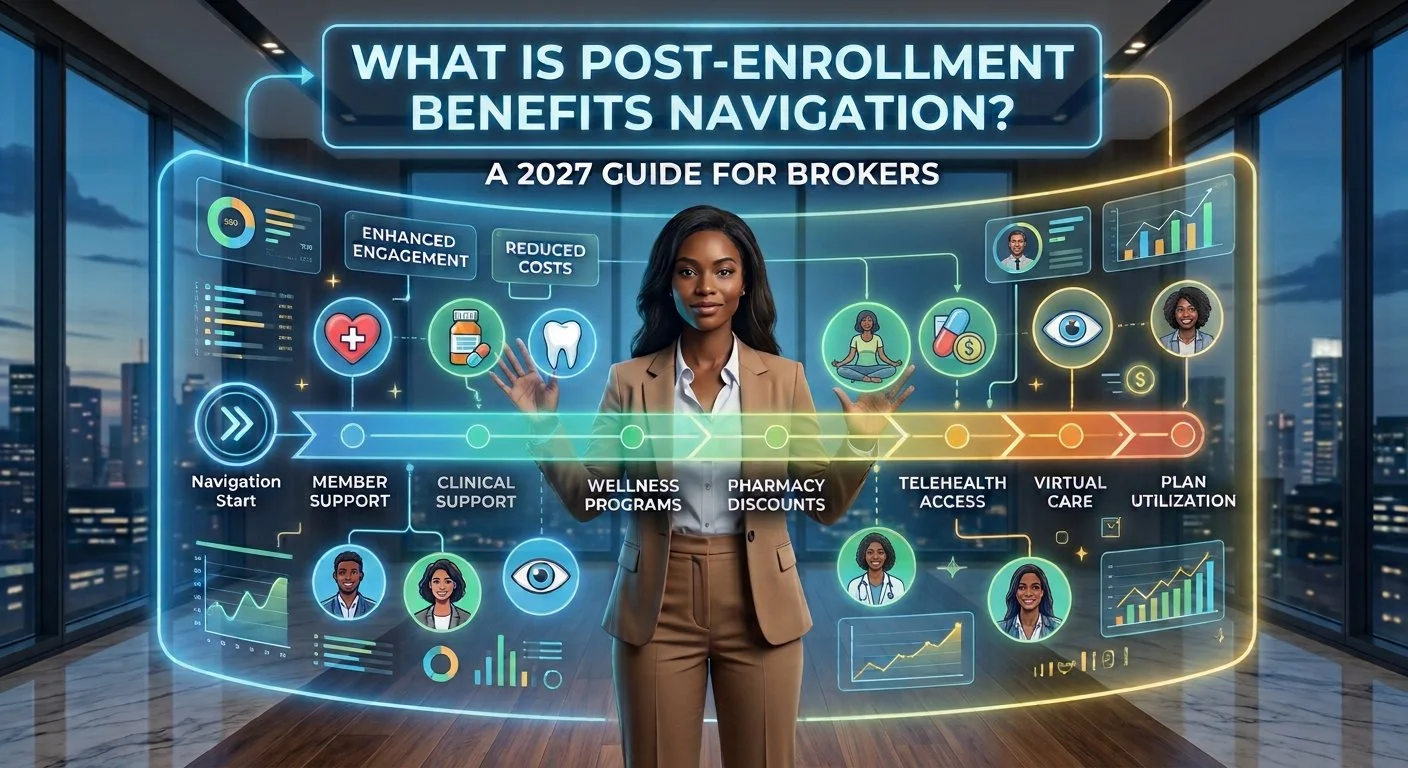
The short answer
Post-enrollment benefits navigation is the year-round help a member gets after a health plan is chosen. It answers what's covered, which doctors are in network, how a prescription is priced, and where to get care. It doesn't pick plans or run enrollment. For independent brokers, it turns the questions that already flood their inbox into a service clients value and a recurring per-member revenue line.
What is post-enrollment benefits navigation?
Post-enrollment benefits navigation is member support that starts the day coverage starts. A member has a plan. Now they need to use it. Navigation answers the practical questions that come up all year:
Is this doctor or facility in my network?
What will this visit cost me under my deductible and coinsurance?
Is my prescription on the formulary, and at what tier?
Should I use virtual care, urgent care or the ER?
What else did I elect that I'm not using?
It is not plan selection, plan comparison or enrollment. The broker still sources and renews the plan. Navigation helps members get value from the plan they already have.
Why members need navigation help
Most people don't understand their health insurance. In a 2017 UnitedHealthcare survey, only 9% of Americans could correctly define premium, deductible, out-of-pocket maximum and coinsurance. Those four terms decide what almost every claim costs.
When members can't decode their plan, three things happen. They call someone, usually HR or the broker. They guess, and sometimes guess wrong on network or site of care. Or they skip care they need. Each outcome costs someone money.
Why the broker ends up owning it
Members rarely call the carrier first. They call the person their HR team trusts, and that's the broker. A single member question takes a broker's team about 17 minutes to answer on average. Multiply that across a book of business in January and service capacity disappears.
The broker already has the relationship and already takes the calls. The question is whether those calls stay a cost or become a service.
How post-enrollment navigation works
Plan data goes in. The member's actual plan documents become the source of truth: summary of benefits and coverage, network, formulary.
Members ask in plain language. By app or chat, the way they'd ask a friend.
Answers come from their plan only. A closed-loop model answers from health insurance and the member's plan. It does not give general answers.
Complex cases go to people. Claims disputes or prior authorization escalate to a support desk.
The broker sees the pattern, not the person. Aggregate trends show what members struggle with. Individual questions stay private to the member.
With Benefitly, that cycle brings the average member interaction from about 17 minutes down to about 5.
7 best practices for brokers offering navigation
1. Keep navigation and plan selection separate. Navigation earns trust by answering from the plan the member already has.
2. Start at renewal. The account is already being re-papered. Adding navigation is one more line on a conversation already underway.
3. Answer from the member's actual plan. Generic explainers don't tell someone whether their dermatologist is in network.
4. Protect member privacy by design. The safest model shows a member's questions to no one but that member, including the broker.
5. Build a human escalation path. Decide up front where complex questions go and how fast they get answered.
6. Launch before the plan year starts. Members who have the app before January 1 use it when the questions hit.
7. Report on themes, not individuals. Show the employer what members struggle with so renewal conversations start with data.
How navigation compares to the alternatives
Post-enrollment navigation: answers from the member's plan, available after hours, plain English by design, keeps member questions private, and earns the broker per-member revenue.
Carrier member services: answers from the plan, one carrier at a time, with limited hours. The broker has no control over the experience.
Broker service team: answers after research, during business hours. It costs the broker staff time on every question.
HR handles it: often can't answer plan-specific questions, has no after-hours coverage, and members hold back sensitive questions.
Common pitfalls
Selling navigation as plan advice. It helps members use coverage, not choose it.
Launching with no member communication. Pair launch with open enrollment materials and a January reminder.
Treating it as a one-time setup. Plans change at renewal. Navigation has to load the new plan data every year.
Using general AI chat tools. A general chatbot will answer confidently about plans it has never seen.
Questions to ask a navigation provider
Does it answer from my client's actual plan documents?
Who can see a member's questions?
What happens when a question needs a human?
Does the broker keep the client relationship?
How is the broker paid, and when?
FAQs
Is post-enrollment benefits navigation the same as a benefits administration platform? No. Benefits administration handles enrollment, eligibility and payroll deductions. Navigation starts after enrollment and helps members understand and use their coverage.
Does navigation recommend health plans? Not in Benefitly's model. Benefitly has no role in plan selection, comparison or enrollment.
Who pays for benefits navigation? Typically the employer, per employee per month, added through the broker at renewal. The broker earns recurring revenue on each member.
Can the employer see what employees ask? Not with Benefitly. Employers and brokers see aggregate themes only.
Is navigation only for large employers? No. Small and midsize employers often need it most because they have no dedicated benefits staff.
How is navigation different from a general AI chatbot? Benefitly is a closed-loop model that only knows health insurance and the member's own plan.
See it in action
See how brokers add post-enrollment navigation at renewal and earn recurring revenue on accounts they already write. Book a demo!
Source: Healthcare Dive on UnitedHealthcare's consumer survey (2017)
