
What does coinsurance mean? (And how it differs from a copay)
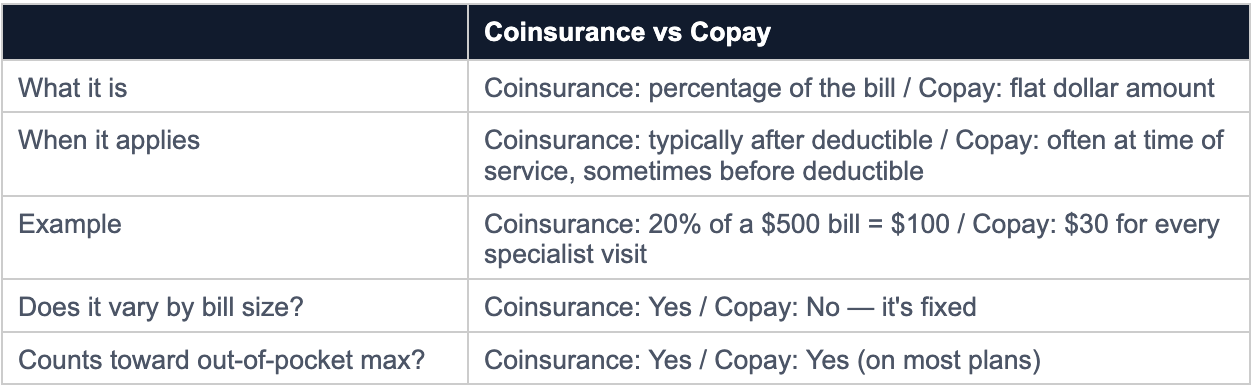
Coinsurance is the percentage of a medical bill you pay after you've met your deductible. If your plan has 20% coinsurance and you get a $1,000 bill after meeting your deductible, you pay $200 and your insurer pays $800. A copay is different — it's a flat dollar amount (like $30) you pay for specific services, regardless of the total bill.
Coinsurance: the percentage you pay after your deductible
Here's how coinsurance works in sequence:
You receive a medical service. The provider bills your insurance company.
Your insurer applies any negotiated discount (the 'allowed amount' or 'negotiated rate').
If you haven't met your deductible yet, you pay the full allowed amount.
Once you've met your deductible, you and your insurer split future costs — that split is your coinsurance.
Once you hit your out-of-pocket maximum, your insurer pays 100% for the rest of the year.
Coinsurance vs copay: a clear comparison
Real-world example
Suppose you need an MRI that costs $2,400. Your plan has a $1,500 deductible with 20% coinsurance. You've already paid $900 toward your deductible this year. Here's what happens:
You owe the remaining $600 of your deductible (your deductible is now met).
For the remaining $1,800 of the bill, you pay 20% coinsurance: $360.
Your insurer pays the remaining $1,440.
Your total out-of-pocket for this MRI: $960.
Frequently asked questions
Is 20% coinsurance good or bad?
It depends on your plan's premium and deductible. A plan with 20% coinsurance and a low deductible may cost more upfront but protect you better from large bills. There's no single 'good' coinsurance rate — it has to be evaluated in the context of your full plan.
Do copays count toward my deductible?
On some plans, yes — but on many plans, copays do not count toward the deductible. They almost always count toward your out-of-pocket maximum. Check your SBC.
What does '80/20' coinsurance mean?
It means your insurer pays 80% of covered costs after your deductible and you pay 20%. This is one of the most common coinsurance splits.
